Blue Dream sounds like somebody named a strain after the afternoon they were hoping to have. A little creativity. A little calm. Absolutely no unexpected meeting invitations.
But a good strain guide needs to get past the name. What is Blue Dream? Why do people describe it as both uplifting and relaxing? And how much can you really learn from “sativa” printed on a package?
Blue Dream was the subject of an early Cannabis School strain episode. This guide pairs that conversation with a closer look at genetics, product chemistry, and the questions worth asking before choosing a batch.
Listen to Blue Dream on Spotify or Apple Podcasts.
What is Blue Dream?
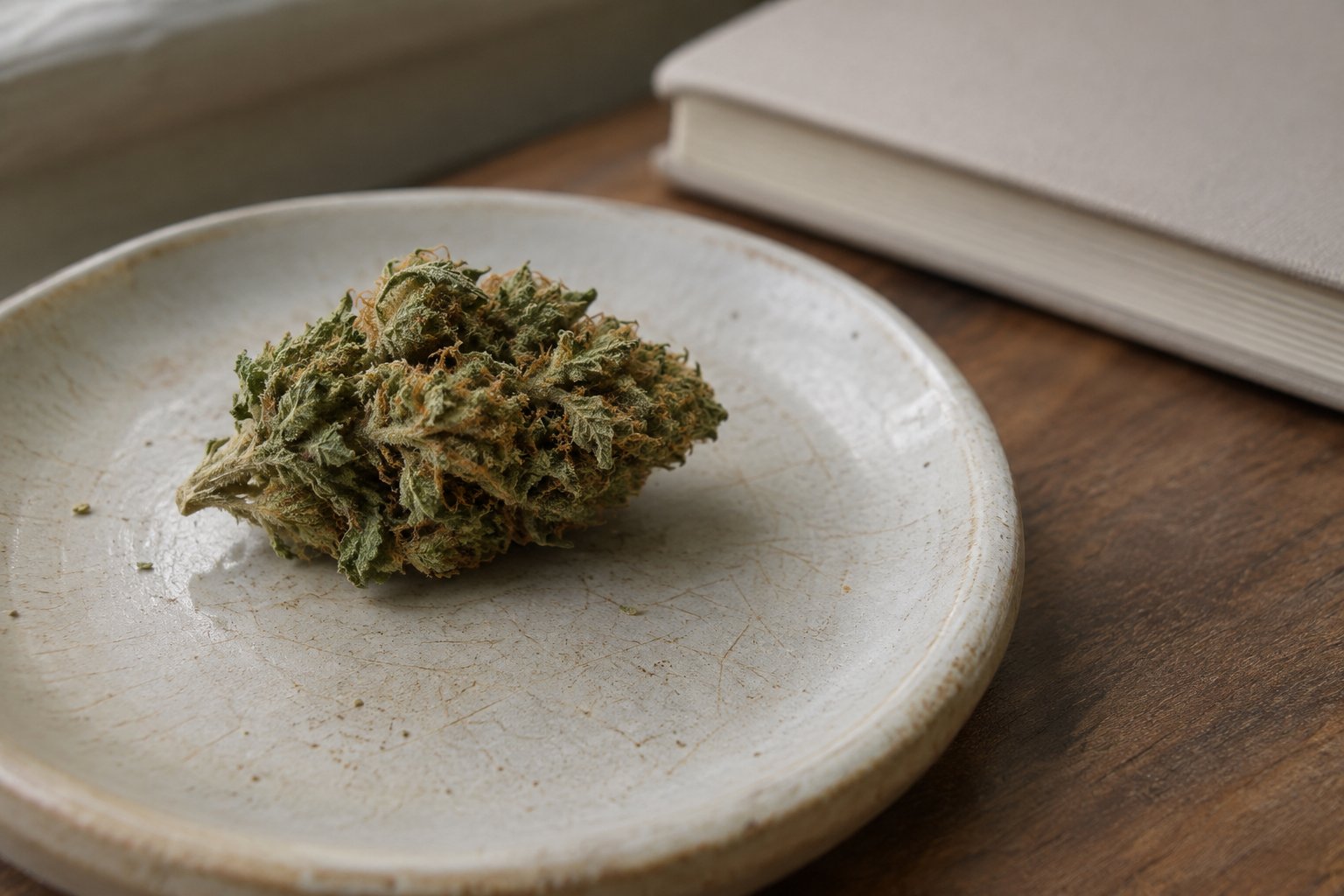
Blue Dream is commonly described as a sativa-dominant hybrid associated with Blueberry and Haze genetics. Humboldt Seed Organization identifies its commercial version as Blueberry crossed with Super Silver Haze. That’s a breeder’s description of its version, not proof that every product sold under the name shares an identical genetic history.
Think of the name as a starting point for a conversation. The grower, product, and batch still deserve their own introduction.
Flavor and aroma: more than “it smells like weed”
Our current episode notes describe sweet berry, herbal, pine, and earthy characteristics. Humboldt’s description emphasizes citrus, cedar, pine, incense, and sweet fruit. Those descriptions overlap, but they aren’t identical.
That’s a useful reminder to describe what you actually notice instead of trying to pass a smell test somebody else wrote.
When evaluating flower, ask: Is the sweetness more fruit-like or candy-like? Is the sharper note pine, citrus, or something herbal? Does the flavor resemble the aroma? Write down your own answer before reading a page of tasting notes. “I don’t pick up blueberry” is a perfectly acceptable observation.
Blue Dream’s terpenes: look for a pattern, then check the batch
There is more to this than internet repetition. A 2022 PLOS ONE study analyzed commercial cannabis testing data and found that 88.5% of the Blue Dream products included in its product-level comparison fell into a chemical cluster characterized by relatively high myrcene and pinene.
That number does not mean a jar contains 88.5% terpenes. It describes how frequently products in that dataset fit a chemical grouping. Nor does it prove identical effects. The study examined chemistry, not how Blue Dream made consumers feel, and its authors noted variation even among relatively consistent names.
Our episode notes also name caryophyllene and limonene. Treat those as compounds to look for on a current lab report, rather than a fixed recipe every Blue Dream must follow.
- Myrcene: a useful name to recognize when comparing Blue Dream terpene reports. Its presence alone does not establish that a product will make you sleepy.
- Pinene: pay attention to whether the report lists alpha-pinene, beta-pinene, or both. Keep those details when comparing products instead of treating every label as the same measurement.
- Beta-caryophyllene and limonene: check whether they’re measured in your batch and at what amounts. A mention in a strain description cannot establish their concentration in your product.
A practical approach: compare the leading terpenes, their amounts, and your experience across products. That gives you a record to work from without declaring that one molecule explains your entire afternoon.
Do terpenes actually change the effects?
It’s a fair question. “Myrcene equals couch” and “pinene equals focus” are tidy explanations. Tidy doesn’t make them established facts.
There is emerging human research on specific combinations. In a small controlled study reported by Johns Hopkins in 2024, vaporized d-limonene reduced some subjective anxiety effects when combined with THC. That experiment did not test Blue Dream flower or prove that a limonene-containing strain prevents anxiety. It also did not establish that participants were unimpaired.
The useful position is curiosity with boundaries: terpene research matters, while a product’s terpene list is not a prescription for a predictable mood. Don’t add essential oils to cannabis or inhale them to imitate a laboratory experiment.
THC, CBD, and the numbers on the label
There is no single THC percentage that defines every Blue Dream. The potency range in a strain description is background information. Your batch’s label and matching laboratory report are the relevant records for the product you actually have.
Check whether a number refers to THC, THCA, or total THC. Don’t add THC to a total-THC figure that already accounts for it. Look for CBD and other measured cannabinoids, too, rather than assuming they’re absent because they weren’t mentioned in the product description.
Units matter. A terpene result of 0.5% by weight equals 5 milligrams per gram of tested material. It does not mean you inhale or absorb 5 milligrams whenever you use the product.
Two jars can have the same strain name and different reports. Comparing the actual numbers is more informative than assuming the larger THC percentage wins.
What might Blue Dream feel like?
The current Cannabis School episode description presents Blue Dream as uplifting, creative, and physically relaxing. Those are descriptions of its reputation and the show’s published notes, not a guarantee for your next session.
According to the CDC, cannabis effects depend on factors including the amount used, previous experience, biology, frequency, consumption method, and other substances. Cannabis can also cause anxiety or paranoia. A familiar strain name doesn’t cancel those possibilities.
“Daytime strain” is not permission to drive, operate equipment, or assume your judgment is unaffected. The CDC warns that cannabis can impair reaction time, coordination, and decision-making. Plan transportation before consuming.
Five questions worth asking about your Blue Dream
- Who grew or made this specific product?
- Does the laboratory report match its batch or lot number?
- What cannabinoids and terpenes were actually measured?
- Am I comparing flower with flower, or very different product types?
- What did I use, how much did I use, and what did I notice afterward?
A simple journal can hold the grower, batch, product type, amount, aroma, and your own observations. You don’t need a laboratory coat. You need enough detail that “that Blue Dream was great” becomes something you can meaningfully compare later.
Keep the curiosity. Read past the name.
Blue Dream offers a useful starting point for learning about strain identity, aroma, and product chemistry. The next step is asking better questions about what’s actually in your jar.
For the conversation behind this guide, join Brandon and Jesse on Spotify or Apple Podcasts. Explore more approachable cannabis education at Cannabis School and in our blog.
Have you tried Blue Dream? Tell us who grew it, what stood out, and whether the experience matched your expectations. The details make the conversation better.
For adult education and entertainment. This article does not establish Blue Dream as a treatment for a medical condition. Discuss medical use and possible medication interactions with a qualified healthcare professional.
Sources
- Humboldt Seed Organization: Blue Dream. Breeder description of its commercial version, not independent clinical evidence.
- Smith and colleagues, 2022: The phytochemical diversity of commercial Cannabis in the United States. Laboratory chemistry study; includes a disclosed Leafly employee affiliation.
- Johns Hopkins Medicine, April 10, 2024: d-limonene and THC research.
- CDC: Cannabis frequently asked questions; mental health; driving.
- Cannabis School’s Blue Dream episode listing and published show notes, linked above.